


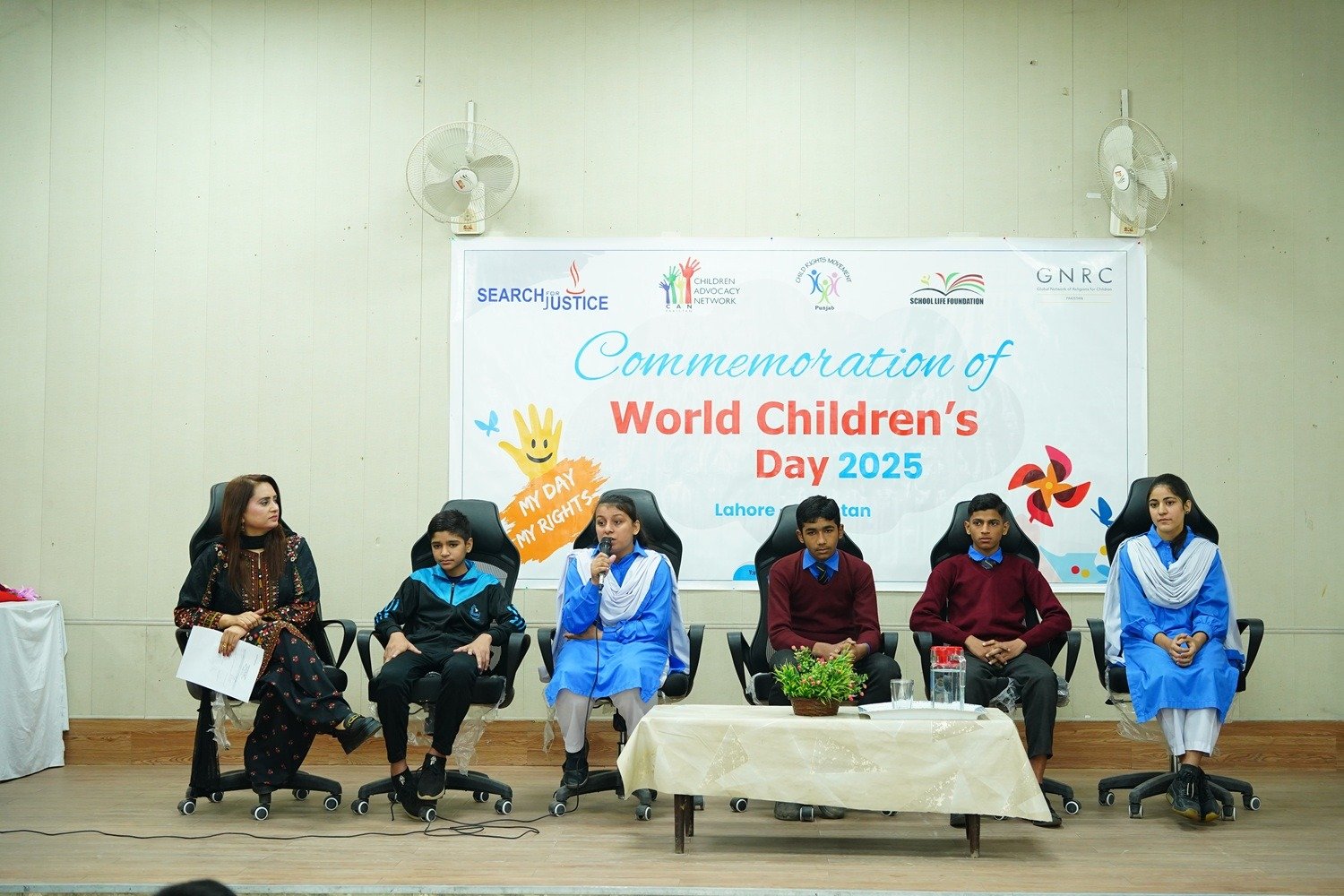
A group of adolescents and young people has called on the government to place child rights at the highest level of national and provincial priorities.
They stressed that children require special and affirmative measures, not symbolic commitments.
They made the demand during a World Children’s Day 2025 commemoration. Search for Justice, the Children Advocacy Network (CAN Pakistan), the Child Rights Movement (Punjab), Climate Action Now–Pakistan, and the Global Network of Religions for Children (GNRC) supported the event.
Saif Ali, a 15-year-old member of the Child Protection Forum of Search for Justice, reminded policymakers that protection from violence, abuse, and exploitation is not optional — it is a legal obligation under the UN Convention on the Rights of the Child and a core commitment under the Sustainable Development Goals. He called on the Prime Minister and all Provincial Chief Ministers to move beyond ad hoc initiatives and adopt a clear, multisectoral plan of action that strengthens child protection systems across health, education, policing, and social welfare.
“Commitments mean nothing without real budgets and real results — actions must speak louder than promises,” Saif asserted.
Bisma Sajid, a child human rights defender, highlighted the growing threat of technology-facilitated gender-based violence. She noted that online harassment, blackmail, non-consensual image sharing, and digital exploitation have become routine risks for adolescent girls, while preventive efforts and policy responses remain weak.
Laiba Khan, 16, emphasized the urgency of addressing adolescents’ psychological and emotional wellbeing. She noted that young people across Pakistan struggle with stress, stigma, and anxiety but often lack access to meaningful support systems. She added that adolescent girls face additional pressures due to social expectations and limited safe spaces.
Search for Justice:
Iftikhar Mubarik, Executive Director of Search for Justice, called for stronger coordination between federal and provincial governments. The step needed to ensure coherent and effective action on children’s rights. He noted that fragmented mandates, overlapping responsibilities, and inconsistent implementation continue to weaken child protection systems across the country — even three decades after Pakistan ratified the UN Convention on the Rights of the Child. Iftikhar emphasized that Pakistan needs a unified framework with shared priorities, clear accountability mechanisms, and harmonized policies so that every province moves in the same direction. Rashida Qureshi, representing the Children Advocacy Network (CAN Pakistan), stressed that Pakistan’s challenge is no longer the absence of laws but the distance between legal commitments and the daily realities of children. She noted that despite new policies and institutional structures, many of these safeguards fail to reach classrooms, streets, or communities where children actually need protection.
Nausheen Adnan, Parliamentary Secretary for the School Education Department, emphasized that the Punjab government is moving beyond statements and taking practical steps to elevate children’s leadership in schools. She explained that student councils have been rolled out across all public schools through a genuinely democratic and child-led process, giving students real influence and strengthening their right to participation. She also noted that, following directives from the Chief Minister, every public school is now required to establish an anti-harassment committee.
Rashida, Mudasser Ahmad and Neeha Munir also spoke on occasion.

