


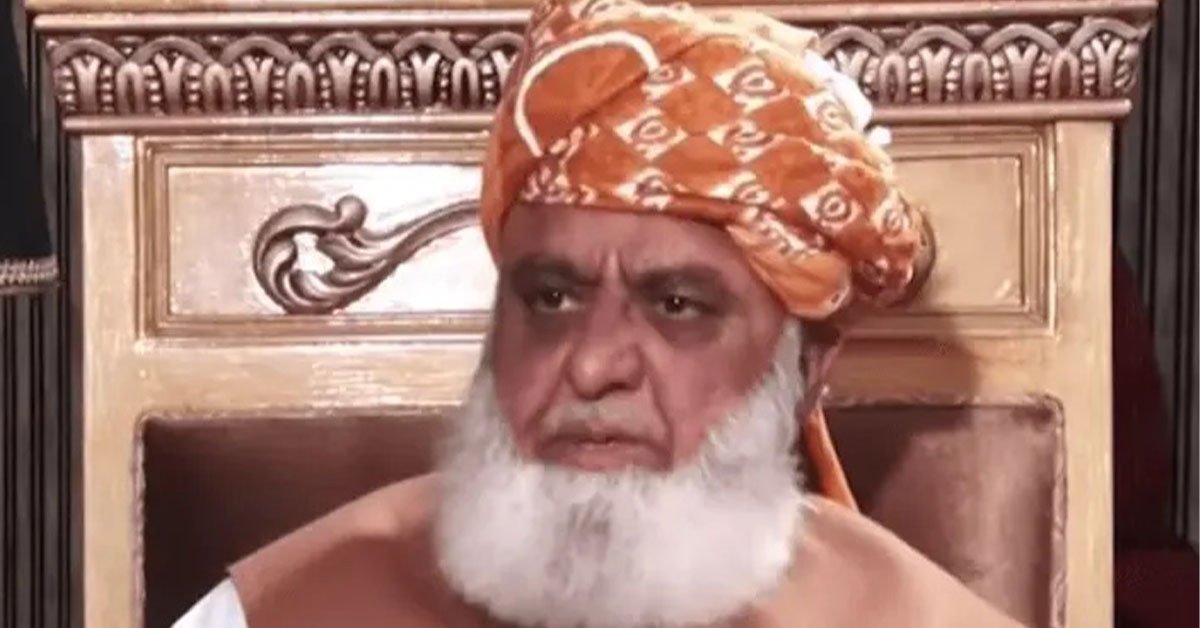
Many analysts in Pakistan believe Maulana Fazlur Rehman, the chief of JUI-F, is a pragmatic politician.
Considered one of the smartest politicians in the country’s history, he has always found a way to stay in the headlines, regardless of how many seats his party holds in parliament. Yet once again, he dominates the political discourse.
After making controversial remarks at a party gathering in Phool Nagar, Kasur, he doubled down in Islamabad.
Ministers and others who had earlier demanded an apology from the Maulana over his remarks against Pakistan’s powerful military establishment have now fallen silent.
The JUI-F chief refused to backtrack. Speaking in Islamabad on Sunday, he adopted an even tougher tone. With much of the mainstream media under tight establishment influence, his speech quickly went viral on social media.
Addressing the JUI-F’s lawyers’ wing, he criticised the establishment for its role in politics and made several other pointed remarks.
Maulana Fazlur Rehman said he respected the institution of the army but was criticising those who controlled the affairs of the state. He also claimed a propaganda campaign had been launched against him after his earlier remarks.
“I will not apologise. Rather, those demanding an apology from me should apologise.”
JUI-F and Powerful Deoband School:
A leading representative of the Deobandi school of thought, Jamiat Ulema-e-Islam (F) is widely regarded as Pakistan’s most influential religious political party.
Maulana Fazlur Rehman, the chief of JUI-F, commands a significant following not only in Pakistan but also in neighbouring Afghanistan. He also enjoys support among sections of religious circles in India and Bangladesh.
Many observers believe the Maulana did not act spontaneously but made a calculated political move.
Some analysts even argue that he enjoys support from certain quarters within the establishment. This raises an obvious question: Why is he taking such an aggressive stance, and why has he launched such a forceful attack on the establishment?
Analysts say a political “change” may be on the horizon. Maulana Fazl has remained dissatisfied with the current civilian-establishment arrangement since the February 2024 elections. Like many others, he believes the present setup emerged from heavily rigged national polls. He is also unhappy with the government’s failure to fulfil its promise of regularising religious seminaries, a commitment that persuaded him to support the 26th Constitutional Amendment.
Pakistan’s political chessboard is once again in motion, and many believe the Maulana’s increasingly direct attacks signal that another political shift may be approaching.


